
The University of Tulsa Home of the Blasco Ibáñez Legacy.
A global destination for research, collaboration, and discovery dedicated to the Valencian novelist who reshaped modern literary realism and political narrative.
Bringing together first editions, rare periodicals, film history, and archival scholarship, The University of Tulsa offers one of the most extensive on-site resources for the study of Vicente Blasco Ibáñez in the United States.

A Vision Rooted in Scholarship
The University of Tulsa has established the Blasco Ibáñez Visiting Scholar Initiative and the Blasco Ibáñez Research Collection to position Tulsa as a leading U.S. center for research on Vicente Blasco Ibáñez, the influential Valencian novelist, journalist, and political writer. By combining an exceptional on-site collection with dedicated support for visiting scholars, the program advances international scholarship on one of Spain’s most consequential literary voices.
Located in McFarlin Library’s Pat and Arnold Brown Reading Room, the Christopher L. Anderson Collection anchors this vision: approximately 715 books, films, and related materials, with a remarkably high concentration of first editions and unique or near-unique holdings in the U.S. and worldwide. The Visiting Scholar Initiative complements these resources with free on-campus lodging, private office space in Oliphant Hall, robust internet and printing access, a daily stipend, and tiered travel support for both domestic and international researchers.
Our mission is to make Tulsa the foremost center for Blasco Ibáñez studies in the United States, offering scholars sustained, in-person engagement with a uniquely rich constellation of texts, archives, and cinematic legacies.
The Christopher L. Anderson Collection of Blasco Ibanez Works
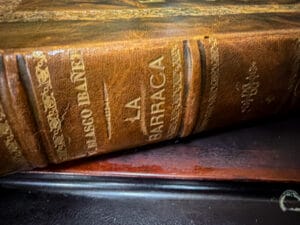
Housed in the Pat and Arnold Brown Reading Room at McFarlin Library, the Christopher L. Anderson Collection offers scholars a concentrated view of Vicente Blasco Ibáñez’s literary, political, and cinematic afterlives. Introduced in 2025, the collection brings together approximately 715 books, films, and related materials, making it one of the most substantial on-site resources for Blasco research in the United States.
According to WorldCat, at least 32 items held here are not found in any other library worldwide; 92 more are held only at Tulsa within the U.S., and another 60 appear in just two or three U.S. libraries. Taken together, these 184 items represent more than a quarter of the collection and underscore its rarity for scholars seeking primary and early reception materials.
715+ books, films, and related materials devoted to Blasco Ibáñez and his reception.
32 works unique worldwide, with dozens more held only at Tulsa or at a small handful of U.S. institutions.
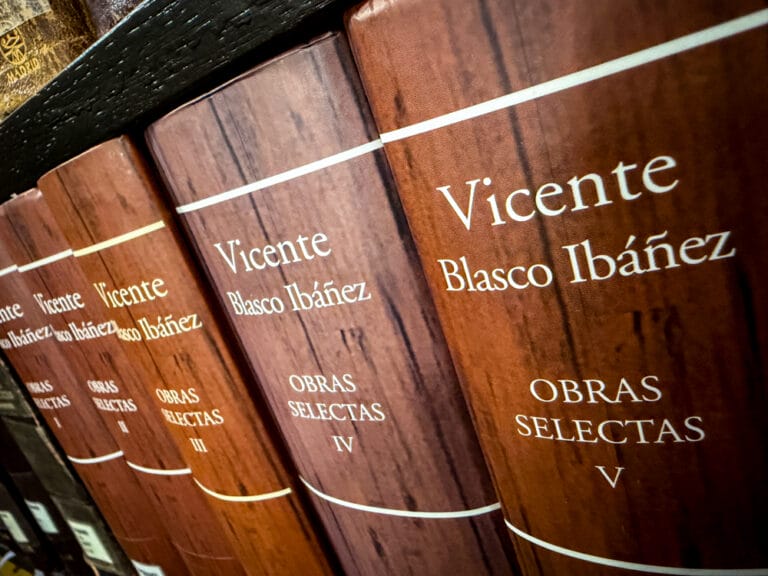
Over 80% of 77 Blasco-related titles include true first editions, spanning novels, story collections, historical and political writings, social commentary, speeches, and travelogues.
Arte y Libertad
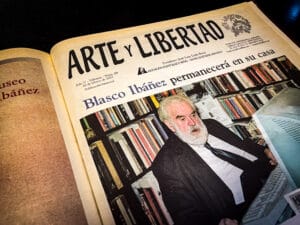
The collection also preserves the only U.S. copy (though incomplete) of Arte y Libertad, the Valencia-based, Blasco-centered periodical that, beginning in 2000 under editors J.L. León Roca, Francisco Carsí, and later Amparo Ferrer, brought thousands of Valencians a bimonthly publication dedicated to their native son and to the cultural history of the region.
Beyond the shelves
Visiting scholars also benefit from Dr. Anderson’s private archive, which complements the library holdings with approximately 1,700 chapters, articles, reviews, theses, and other writings, along with around 2,900 newspaper clippings, advertisements, and announcements from major U.S. newspapers such as The New York Times, Philadelphia Enquirer, Chicago Tribune, Los Angeles Times, and San Francisco Chronicle.
First Editions and Authorial Presence
Among the collection’s 77 Blasco-related titles, more than four-fifths include true first editions, allowing scholars to work closely with the texts as they first entered the literary marketplace. This concentration of first printings—across novels, political essays, social commentaries, and travel narratives—makes it possible to track authorial revisions, publisher strategies, and the evolution of Blasco’s public image through bindings, covers, and other paratextual details that are often lost in later reprints.
For Visiting Blasco Ibanez Scholars
The Blasco Ibáñez Visiting Scholar Initiative welcomes researchers from around the world who wish to work closely with primary editions, reception history, and archival materials on Vicente Blasco Ibáñez. Scholars at all career stages are invited to reside on campus, use McFarlin Library and Oliphant Hall as their daily base of operations, and contribute to an ongoing international conversation on Blasco’s literary and cultural legacy.
Scholar Benefits
On-campus lodging
Up to one month of free, high-quality apartment lodging on the TU campus, located a five–seven minute walk from McFarlin Library.
Dedicated office space
A private office in Oliphant Hall, home to the School of Language and Literature, with free access to printers and copiers.
Seamless connectivity
Free internet access in the office, at McFarlin Library, and in the on-campus apartment, supporting sustained daily work with both print and digital resources.
Daily stipend
A $30 per diem from the Blasco Ibáñez Fund to help cover meals and incidental expenses during the stay.
Travel support
Travel funding of up to $1,000 for international visitors and up to $500 for domestic visitors whose home institutions do not provide travel support.
Enhanced research access
Full use of the Christopher L. Anderson Collection at McFarlin Library, together with Dr. Anderson’s private archive of approximately 1,700 scholarly writings and 2,900 newspaper articles, ads, and announcements related to Blasco Ibáñez’s international reception.
Connection to programming
Opportunities to align research visits with events such as TU’s Comparative Literature Symposium on Blasco Ibáñez and World War I, Circle Cinema screenings of The Four Horsemen of the Apocalypse, and presentations of the docudrama The Fifth Horseman: A Vision of World War I.
Scholarly Environment
McFarlin Library
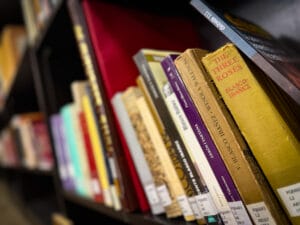
Pat and Arnold Brown Reading Room, where the Anderson Collection invites close work with first editions, rare periodicals, and reception documents.
Oliphant Hall
A quiet office in the School of Language and Literature that places visiting scholars in daily contact with faculty working in Hispanic studies, comparative literature, and film.
Tulsa as context

An arts-oriented city where previous Blasco events have included museum visits, historic Art Deco walks, and public film discussions that link Ibáñez’s work to broader cultural histories.
Inquiries about the Blasco Ibáñez Visiting Scholar Initiative may be directed to Dr. Christopher L. Anderson through the program’s contact form.
Scholar in Residence: Dr. Cécile Fourrel de Frettes
In early 2025, Dr. Cécile Fourrel de Frettes, Assistant Professor at Université Sorbonne Paris Nord, undertook a month-long research stay at McFarlin Library to work on Vicente Blasco Ibáñez’s “social novels.” Centering her project on La Catedral, El intruso, La bodega, and La horda, she drew on rare first editions, early biographical studies, and a wide range of critical materials that are difficult or impossible to access in France or Spain.
Working across both the Christopher L. Anderson Collection and the associated archive of press materials and scholarship, Dr. Fourrel de Frettes reconstructed the early academic Hispanism that helped shape the international reception of Blasco Ibáñez. Her research catalogued over thirty bibliographic entries spanning primary editions, early biographies, foundational critical studies, and modern scholarship, directly advancing her forthcoming publication on the social novels.
She describes the Tulsa collections as “a decisive source of inspiration and information” for both her book project and for deepening her understanding of the history of academic Hispanism around Blasco Ibáñez
Her stay also contributed to a broader aim of the Visiting Scholar Initiative: strengthening academic collaboration among France, Spain, and the United States around Blasco studies.
Key Works Studied
- La Catedral (1903)
- El intruso (1904)
- La bodega (1905)
- La horda (1905/1906)
Research Layers Consulted
- Multiple primary editions across the 20th and 21st centuries
- Early biographical accounts (ca. 1900–1978)
- Early critical and Hispanist studies (1908–1972)
- Modern scholarship through the early 21st century
Outcomes
- Identification of rare and out-of-print editions unavailable in her home country
- Enriched reconstruction of Blasco Ibáñez’s early and modern reception
- Strengthened cross-national collaboration between France, Spain, and the U.S.
A Global Network of Inquiry
The Blasco Ibáñez initiative at The University of Tulsa is conceived as a meeting point rather than an endpoint—a place where scholars from Europe, the Americas, and beyond can read Blasco side by side with the political, cinematic, and reception histories that shaped his afterlife. Researchers from Hispanic studies, comparative literature, film studies, and history use the Tulsa collections to pursue questions that cross borders: from Valencian modernity to French Hispanism, from the transatlantic circulation of Los cuatro jinetes del Apocalipsis to contemporary re-readings of his social novels.
By supporting on-site residencies and fostering collaborations with institutions in Spain, France, and Latin America, the program aims to situate Blasco Ibáñez where he has always belonged: at the intersection of national and international debates on democracy, secularism, class conflict, and cultural modernity. For Blasco, art and liberty were inseparable; for this initiative, his work is a catalyst for critical dialogue across languages and time.
Continue the Journey
The story of Vicente Blasco Ibáñez is still being written—across archives and reading rooms, in classrooms and cinemas, in new critical studies that return to his novels with fresh questions. At The University of Tulsa, the Anderson Collection and the Visiting Scholar Initiative exist so that this rediscovery can happen in person: with first editions in hand, newspapers on the table, and time set aside for sustained, undistracted inquiry.
Whether your work turns on the social novels, the war fiction, the political essays, or the global afterlives of The Four Horsemen of the Apocalypse, Tulsa offers a place to linger with the materials and to think alongside others who care about Blasco’s legacy. We invite you to make this collection part of your own research journey.